
Red teaming is a goal-based simulation of a real attack against your organisation. Instead of testing one application, a red team tries to achieve a specific objective, such as reaching sensitive data or a critical system, while staying hidden from your defenders.
The main question red teaming answers is not “what vulnerabilities do we have?” but “could a determined attacker achieve their goal, and would we notice?”
Red teaming vs penetration testing vs vulnerability assessment
These three services are often confused. They complement each other, but they are not the same.
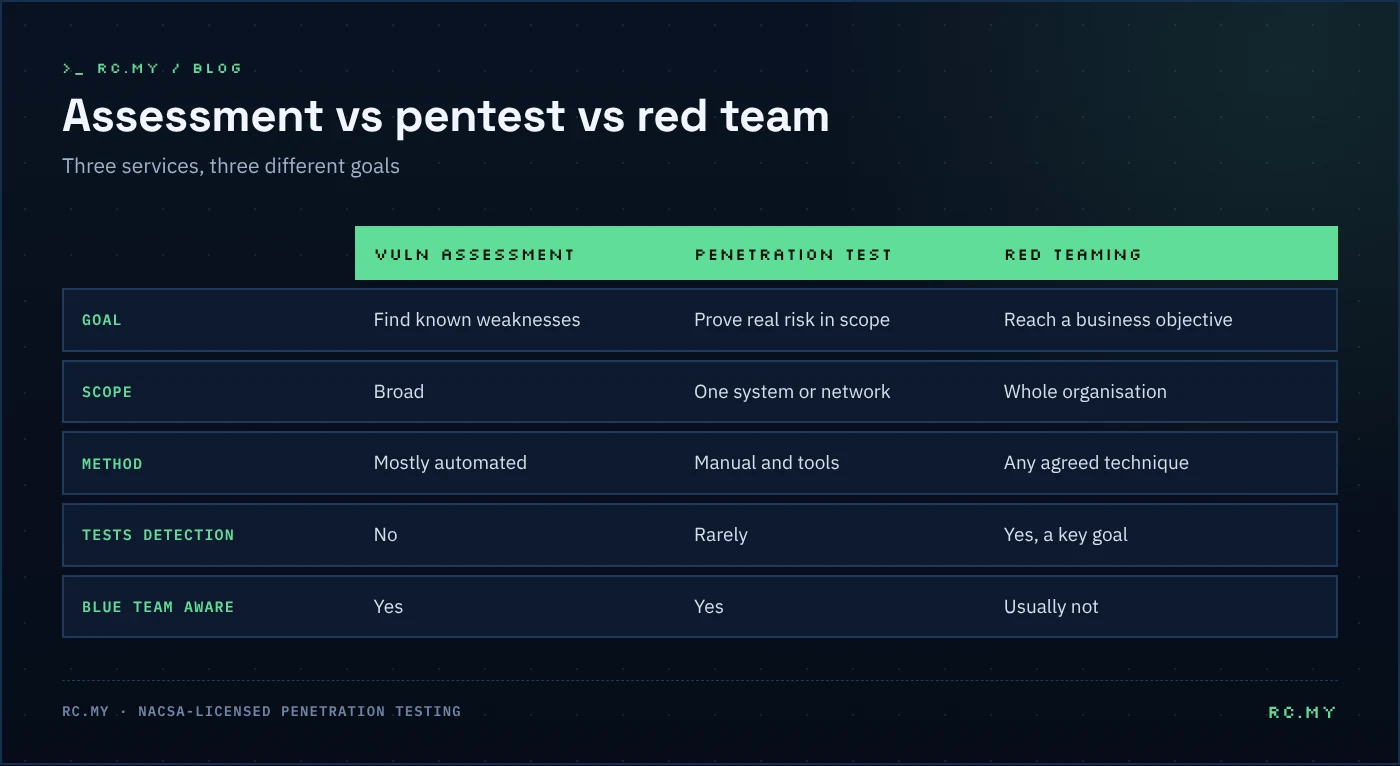
- Vulnerability assessment finds as many known weaknesses as possible, mostly with automated tools. It is broad and fast.
- Penetration testing proves which weaknesses are real within an agreed scope, such as one web application or network. It is deep but focused. Read what is penetration testing for details.
- Red teaming pursues a business objective across the whole organisation, using any agreed technique, and tests detection and response as much as prevention.
In short, a penetration test asks “how many ways in are there?”, while red teaming asks “can someone get to what matters, and will we catch them?”
What red teaming tests
A red team engagement looks at three layers together:
- People. Do staff report suspicious emails, calls or visitors?
- Processes. Do alerts reach the right people, and do they act on them in time?
- Technology. Do your endpoint protection, monitoring and logging actually detect real attack techniques?
Because of this, red teaming is most valuable for organisations that already have a security operations function, such as a security operations centre or a managed detection service.
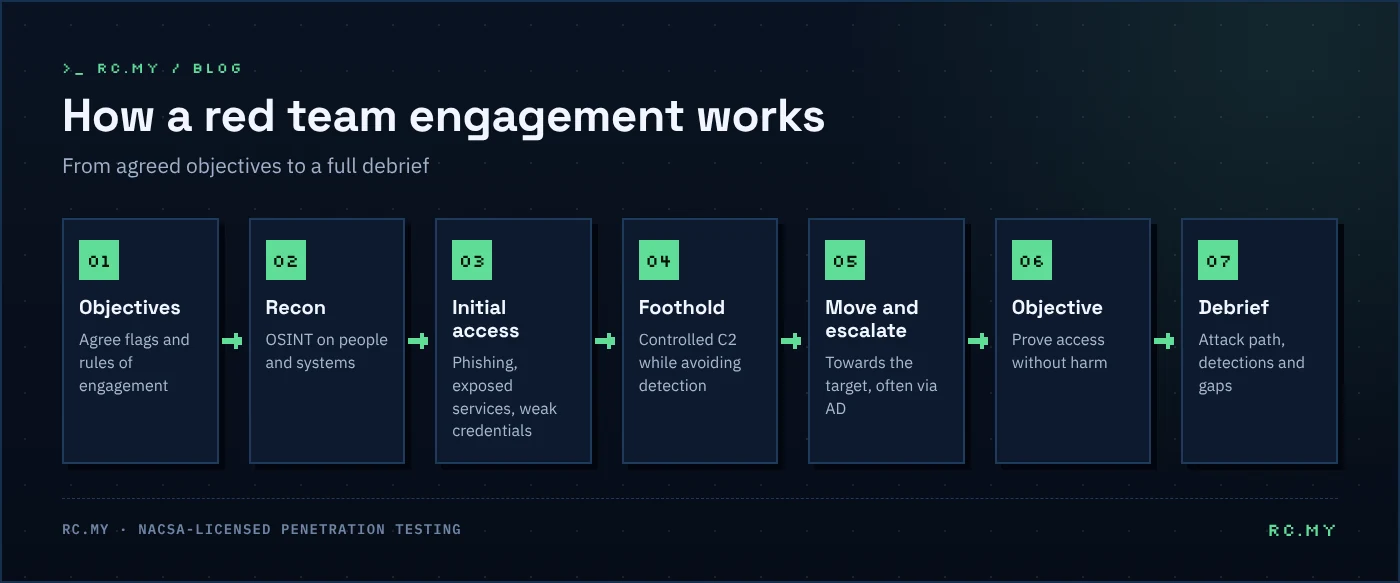
How a red team engagement works
- Objectives and rules of engagement. Leadership agrees on goals, often called “flags”, such as accessing a finance system or a customer database. Limits are set on what is allowed, and a small group of “white team” contacts is informed.
- Reconnaissance. The red team gathers open-source intelligence on staff, technologies and external systems.
- Initial access. Common routes include phishing, exposed services, weak credentials or, if agreed, physical access.
- Establishing a foothold. The team sets up controlled command-and-control channels while trying to avoid detection.
- Lateral movement and privilege escalation. The team moves towards the objective, often through identity systems such as Active Directory.
- Achieving the objective. The team proves access to the target without causing harm.
- Reporting and debrief. The report shows the full attack path, what was detected, what was missed and how to improve.
Many teams map their techniques to the MITRE ATT&CK framework, so defenders can see exactly which behaviours were or were not detected.
Purple teaming: learning together
In a purple team exercise, the red team and the defenders (the blue team) work side by side. The red team runs a technique, the blue team checks whether it was detected, and both sides tune detections in real time.
Purple teaming is an excellent next step after a red team engagement, or a good starting point for organisations that are building their detection capability.
When should you consider red teaming?
Red teaming is usually the right choice when:
- You already run regular penetration tests and fix the findings.
- You have monitoring in place and want to know whether it works under pressure.
- Your board or regulator wants assurance against realistic, targeted attacks.
- You hold high-value data or run critical services.
If you have not yet run regular penetration tests, start there. Red teaming delivers the most value once common vulnerabilities are under control.
Planning a safe red team engagement
Because red teaming is realistic, careful planning protects the business:
- Get written authorisation from senior management.
- Agree what is out of scope, such as production outages or certain staff.
- Set up a fast way to pause the exercise if something unexpected happens.
- Make sure any phishing or social engineering follows your legal and HR guidelines.
- In Malaysia, work with a provider licensed by NACSA under the Cyber Security Act 2024.
Frequently asked questions
How long does a red team engagement take?
Typically several weeks. Realistic attackers move slowly to avoid detection, so a meaningful exercise needs time.
Does the security team know about red teaming in advance?
Usually not. Only a small white team knows, so that detection and response can be tested honestly.
Is red teaming only for large companies?
It is most common in larger or highly regulated organisations. Smaller teams often gain more from penetration testing combined with a focused purple team workshop.
Explore adversary simulation with RC.MY
RC.MY offers adversarial testing, including phishing, social engineering, intrusion simulation and evasion. Learn more about our cybersecurity services or contact us to discuss your objectives.