

Before a penetration test starts, you decide how much information the tester receives. This choice shapes what the test can find. Black box testing, grey box testing and white box testing are the three common approaches, and each has a clear place.
If you are new to the topic, read what is penetration testing first.
What is black box testing?
In black box testing, the tester starts with almost no information. They may receive only a company name, a domain or an IP range. Everything else, from user roles to technologies, has to be discovered.
This approach closely matches an external attacker with no inside knowledge.
Advantages
- Realistic view of what an outsider can discover and exploit.
- Tests your external exposure, including forgotten assets.
- No preparation needed from your developers.
Disadvantages
- Much of the time is spent on discovery instead of testing.
- Features behind logins or rare workflows may never be reached.
- For the same budget, coverage is usually lower.
Black box testing works best for internet-facing infrastructure, external attack surface reviews and checking what a stranger could learn about you.
What is grey box testing?
In grey box testing, the tester receives partial information. Typically this means test accounts for each user role, basic architecture notes and API documentation.
This approach reflects an attacker who has stolen a user’s credentials, or a malicious insider with normal access.
Advantages
- Far better coverage of authenticated features and access control.
- Good balance between realism and efficiency.
- Ideal for finding privilege escalation, such as one customer reading another customer’s data.
Disadvantages
- Less realistic for testing pure external discovery.
- Requires some preparation, such as creating test accounts.
Grey box testing is the most common choice for web applications, mobile apps and APIs, because most serious issues sit behind the login page.
What is white box testing?
In white box testing, the tester receives full information: source code, architecture diagrams, configuration files and sometimes direct access to developers.
Advantages
- Deepest coverage, including issues that are hard to reach from the outside.
- Findings can point to the exact line of code to fix.
- Very efficient for complex or high-risk systems.
Disadvantages
- Less realistic as an attack simulation.
- Requires sharing sensitive material under a strong agreement.
- Needs testers who can review code as well as attack running systems.
White box testing suits critical systems such as payment flows, authentication services and custom cryptography. It also combines well with secure code review and DevSecOps practices.
Black box testing vs grey box vs white box at a glance
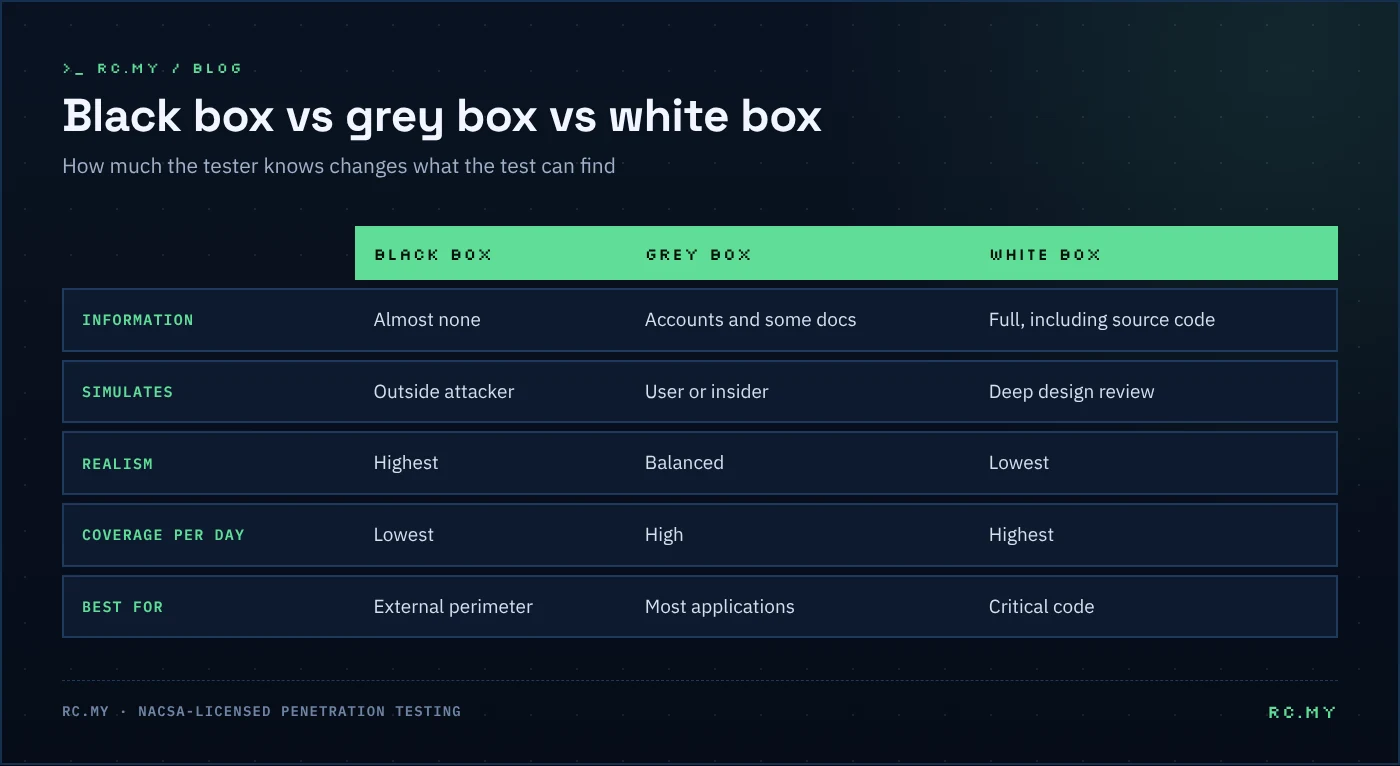
- Information given: black box gets almost none, grey box gets accounts and some documentation, white box gets full access including source code.
- Realism: black box is closest to an outside attacker, grey box to a user or insider, white box is least realistic but most thorough.
- Coverage per day of testing: lowest for black box, highest for white box.
- Best for: black box suits external surfaces, grey box suits most applications, white box suits critical code.
Which approach should you choose?
Ask yourself what you want to learn:
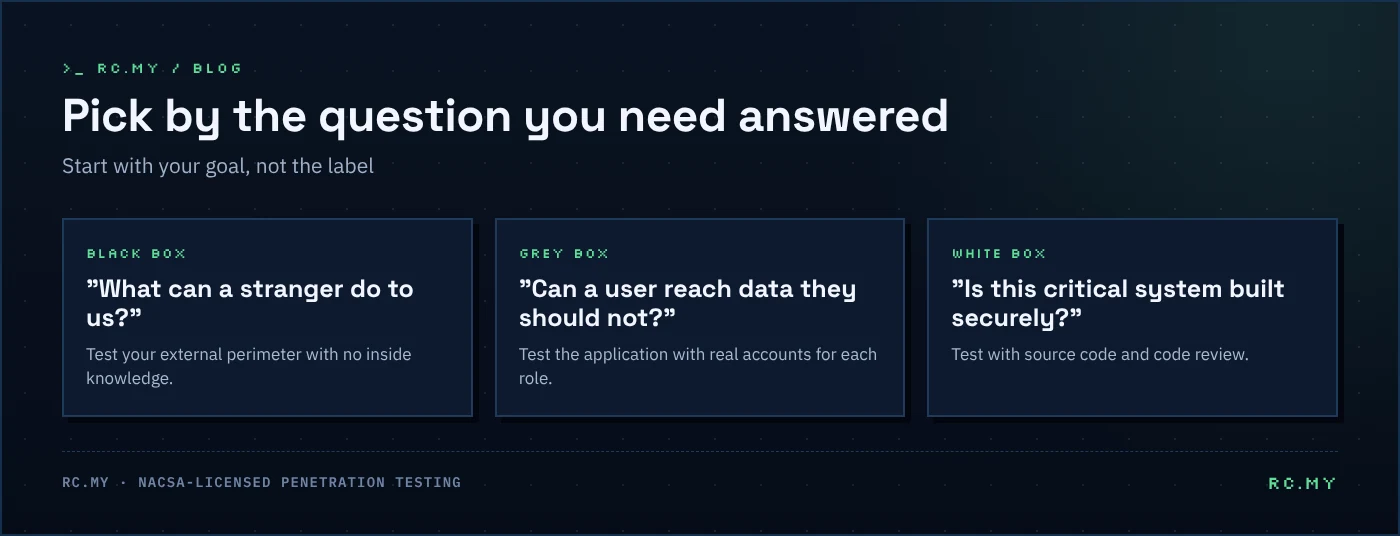
- “What can a stranger on the internet do to us?” Choose black box testing of your external perimeter.
- “Can a logged-in user access data or functions they should not?” Choose grey box testing of your application.
- “Is this critical system built securely?” Choose white box testing with code review.
Many organisations combine approaches. For example, a black box review of the external perimeter followed by a grey box test of the main customer portal gives both breadth and depth. For a full, goal-based attack simulation, consider red teaming.
Frequently asked questions
Is black box testing more accurate?
Not necessarily. It is more realistic for an outside attacker, but with a fixed budget it usually covers less of the application than grey box testing.
Is grey box testing the same as authenticated testing?
They overlap. Authenticated testing means the tester logs in with valid accounts, which is a core part of most grey box tests.
Do I need to share source code for a penetration test?
Only for white box testing. Black box and grey box tests can be performed without access to your code.
Get the right test for your system
RC.MY plans every engagement around your goals, risk and budget, following a recognised penetration testing methodology. See our cybersecurity services or contact our team for a recommendation.