
Cyber threat intelligence (CTI) is information about attackers that has been collected, analysed and put into context so that you can make better security decisions. In other words, it answers practical questions: who is likely to target us, how do they operate, and what should we do about it first?
However, raw data, such as a list of suspicious IP addresses, is not intelligence on its own. It becomes intelligence when someone checks it, connects it to a threat and explains why it matters to your organisation.
Why cyber threat intelligence matters
In reality, security teams never have enough time or budget to fix everything at once. Threat intelligence helps them focus on the threats that are most likely and most damaging for their own sector.
- Better priorities. Patch the vulnerabilities that attackers are actually exploiting, not just the ones with the highest score.
- Faster detection. Feed known malicious domains, file hashes and techniques into your monitoring tools.
- Stronger response. During an incident, knowing the attacker’s usual playbook helps you contain them sooner.
- Informed leadership. Executives can plan budgets and risk decisions based on real threats rather than headlines.
For organisations in Malaysia, cyber threat intelligence also means watching local trends, such as scams and phishing campaigns that use Malaysian brands, government agencies and banks as lures.
The threat intelligence lifecycle
Good cyber threat intelligence follows a repeatable cycle. Each step feeds the next, and then feedback keeps the work useful.
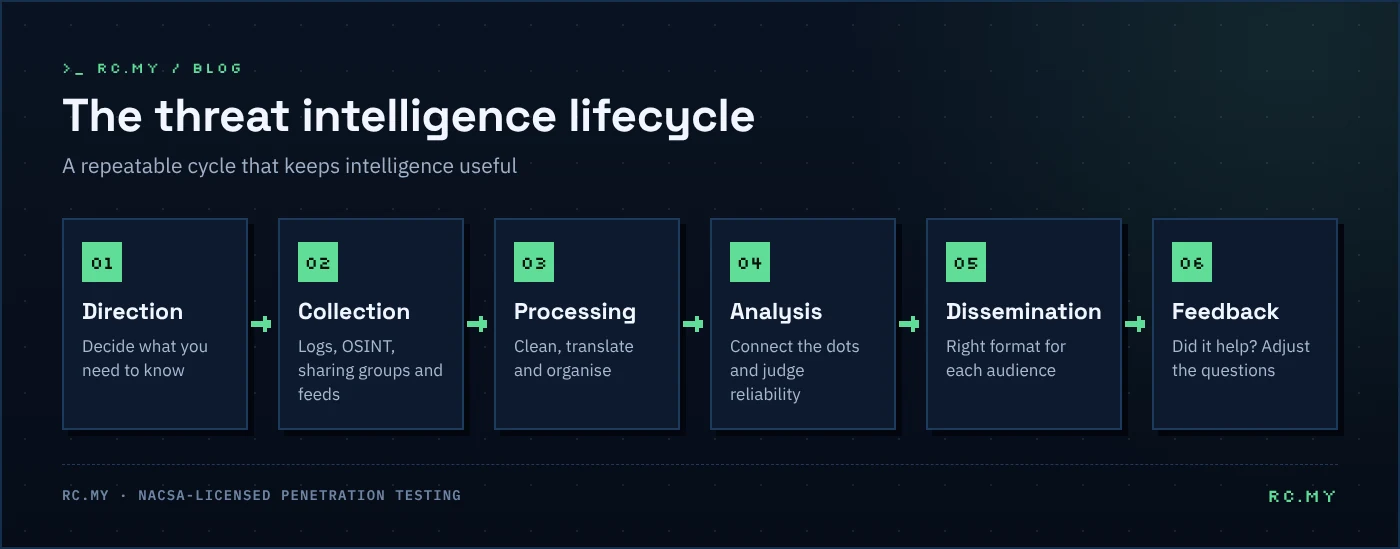
- Direction. Decide what you need to know. For example, “Which groups target payment systems in Southeast Asia?”
- Collection. Gather data from logs, open sources, industry sharing groups, vendor feeds and incident reports.
- Processing. Clean, translate and organise the data so that it can be analysed.
- Analysis. Connect the dots, judge reliability and decide what the findings mean for you.
- Dissemination. Share the result in the right format for each audience, from a one-page brief to a list of indicators.
- Feedback. Ask whether the intelligence helped, then adjust the questions for the next round.
The four types of threat intelligence
Different people need different kinds of intelligence. As a result, most frameworks describe four types.
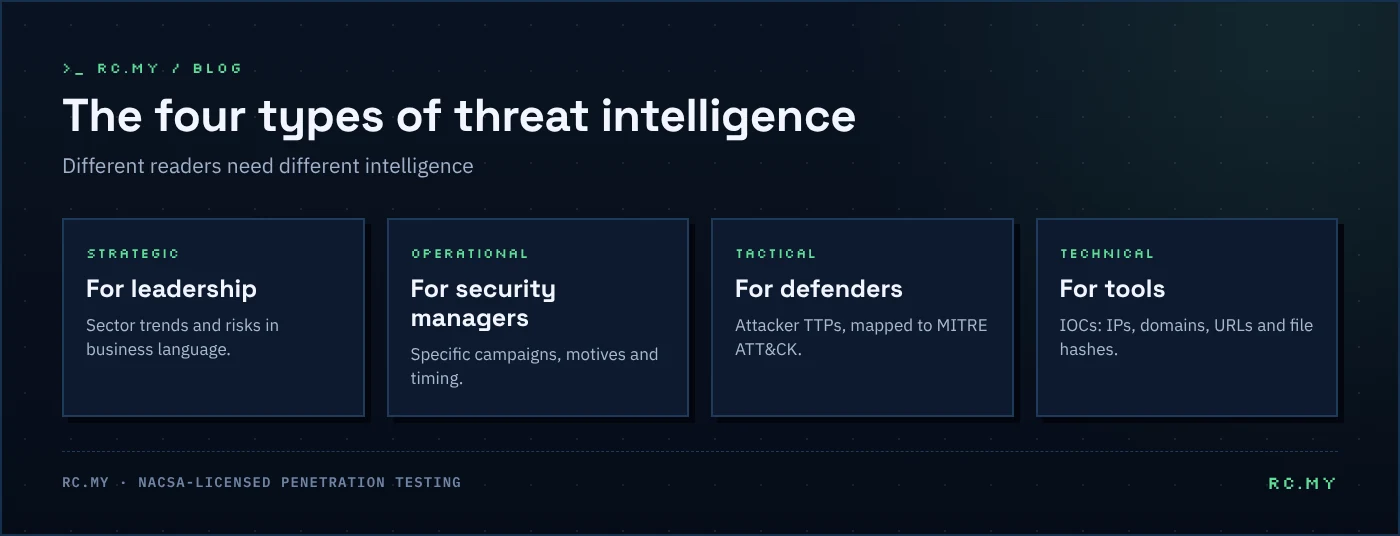
Strategic intelligence
High-level trends for leadership, such as which sectors are being targeted and why. Because it is written in business language, it supports long-term planning and investment.
Operational intelligence
Details about specific campaigns or upcoming attacks, including the attacker’s motives and timing. It helps security managers prepare for a particular threat.
Tactical intelligence
How attackers work: their tactics, techniques and procedures (TTPs). The MITRE ATT&CK framework is the common reference for describing them. Defenders use it to improve detection rules and to plan red team exercises.
Technical intelligence
Specific indicators of compromise (IOCs), such as IP addresses, domains, URLs and file hashes. They are easy to block. However, they also change quickly, so they have a short shelf life.
Where threat intelligence comes from
In practice, useful cyber threat intelligence combines several sources:
- Internal data. Your own logs, alerts and past incidents are often the most relevant source of all.
- Open-source intelligence (OSINT). Public reports, security blogs, paste sites and social media.
- Sharing communities. Industry groups and national bodies share alerts with their members. In Malaysia, MyCERT publishes advisories, and NACSA coordinates national cyber security efforts.
- Commercial feeds. Paid services offer curated indicators and analyst reports.
- Sharing platforms. Open tools such as MISP, together with the STIX and TAXII standards, make it easier to exchange indicators in a consistent format.
How smaller organisations can start
You do not need a dedicated intelligence team to benefit from cyber threat intelligence. Instead, a simple approach works well:
- Write down your top three questions. For example, which ransomware groups target your sector, and which of your systems are exposed to the internet.
- Subscribe to a few trusted sources. National advisories, your vendors’ security notices and one or two quality blogs are enough at first.
- Act on what you learn. Each month, pick the most relevant threat and check whether your controls would stop it.
- Test your assumptions. A penetration test or a threat-led red team exercise shows whether real attack techniques would succeed against you.
Later, as your programme matures, you can automate the feeds into your firewall, email gateway and security monitoring tools.
Common mistakes to avoid
- Collecting everything. Thousands of unfiltered indicators create noise, not insight.
- No clear audience. A technical IOC list is useless to a board, and a strategy brief is useless to a SOC analyst.
- Ignoring internal data. Your own incidents often reveal more than any external feed.
- Never measuring value. If intelligence never changes a decision, the questions need to change.
Frequently asked questions
Is cyber threat intelligence only for large companies?
No. Smaller organisations can start with free national advisories, vendor notices and their own logs. The key is to focus on a few clear questions.
What is the difference between threat intelligence and threat hunting?
Threat intelligence tells you what attackers do. Threat hunting uses that knowledge to search your own environment for signs that they are already inside.
How does threat intelligence relate to penetration testing?
Threat intelligence shows which techniques real attackers use. A penetration testing methodology can then include those techniques, so the test reflects the threats you actually face.
Turn threat intelligence into action
RC.MY helps organisations test their defences against real-world attack techniques through penetration testing and adversarial testing. Explore our cybersecurity services or contact us to discuss your threat landscape.