
DevSecOps means building security into every stage of software delivery, instead of checking it once at the end. Security becomes a shared responsibility of developers, operations and security teams, supported by automation in the CI/CD pipeline.
For teams that release often, DevSecOps is the only practical way to keep security up to speed. This guide covers the core practices, common open-source tools and a simple roadmap.
Why DevSecOps matters
Traditional security reviews happen just before go-live. When a serious issue is found at that stage, fixing it is slow and expensive, and releases get delayed. DevSecOps shifts checks earlier, so problems are caught while the code is still fresh in the developer’s mind.
The benefits are clear:
- Faster fixes, because issues are found in minutes, not months.
- Fewer surprises before launch.
- Better protection against software supply chain failures, now a top risk in the OWASP Top 10:2025.
Security checks across the pipeline
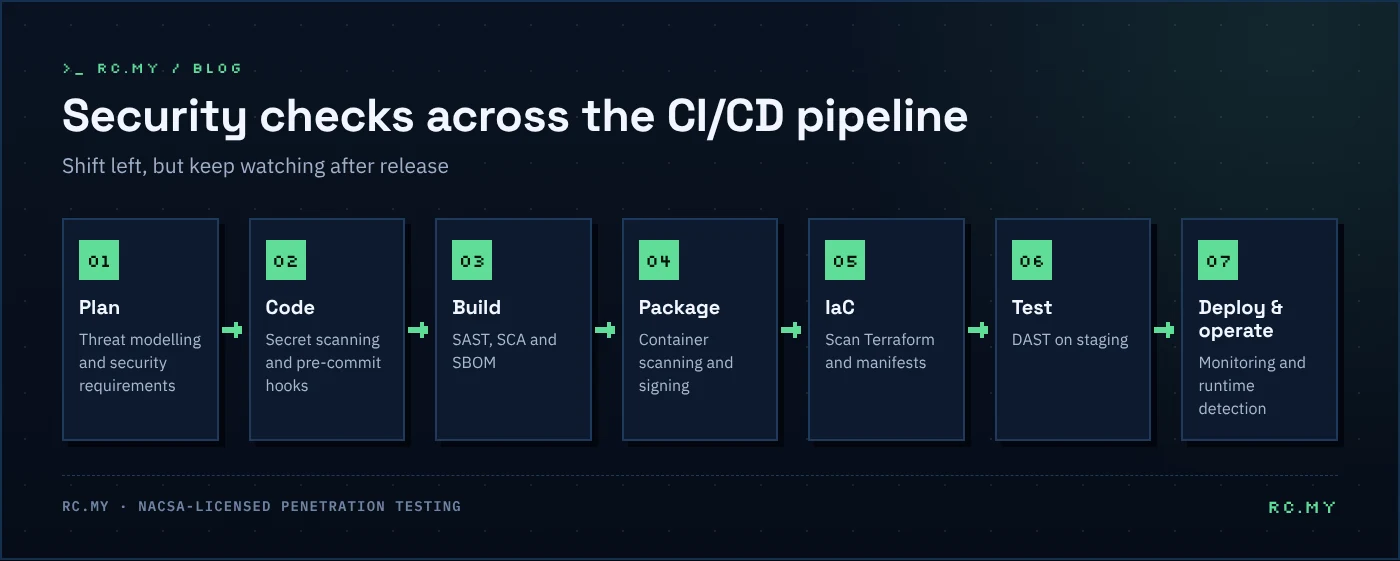
A typical CI/CD pipeline has several stages. Here is where DevSecOps checks fit.
1. Plan and design
Threat model new features and agree on security requirements. Use the OWASP Top 10 and ASVS as a reference.
2. Code
Help developers write secure code from the start:
- Pre-commit hooks for secret scanning, for example with Gitleaks.
- IDE plugins that flag insecure patterns.
- Peer review with a short security checklist.
3. Build
Run automated checks on every pull request:
- SAST (static application security testing) analyses source code for vulnerabilities. Semgrep and SonarQube are popular options.
- SCA (software composition analysis) checks open-source dependencies for known vulnerabilities and licence issues.
- SBOM generation creates a software bill of materials, for example in CycloneDX or SPDX format.
4. Package
Secure what you ship:
- Scan container images with a tool such as Trivy.
- Use minimal base images and remove unused packages.
- Sign images and artefacts, for example with Sigstore Cosign, so you can verify them later.
5. Infrastructure as code
Scan Terraform, Kubernetes manifests and Helm charts before they reach production. Tools such as Checkov and Trivy catch open storage buckets, missing encryption and overly permissive network rules. For cluster hardening, see our guide to Kubernetes security.
6. Test
Run DAST (dynamic application security testing) against a staging environment. OWASP ZAP can be automated in the pipeline for a baseline scan.
7. Deploy and operate
- Store secrets in a vault, never in code or pipeline variables in plain text.
- Use least-privilege credentials for your pipeline.
- Monitor runtime behaviour and centralise logs.
Protect the pipeline itself
Your CI/CD system can deploy to production, so it is a valuable target. Protect it by:
- Requiring reviews and branch protection on main branches.
- Limiting who can change pipeline definitions.
- Pinning third-party actions and plugins to specific versions.
- Rotating credentials regularly.
Frameworks such as SLSA (Supply-chain Levels for Software Artifacts) offer a step-by-step model for improving build integrity.
A simple DevSecOps roadmap
You do not need everything at once. A practical order is:
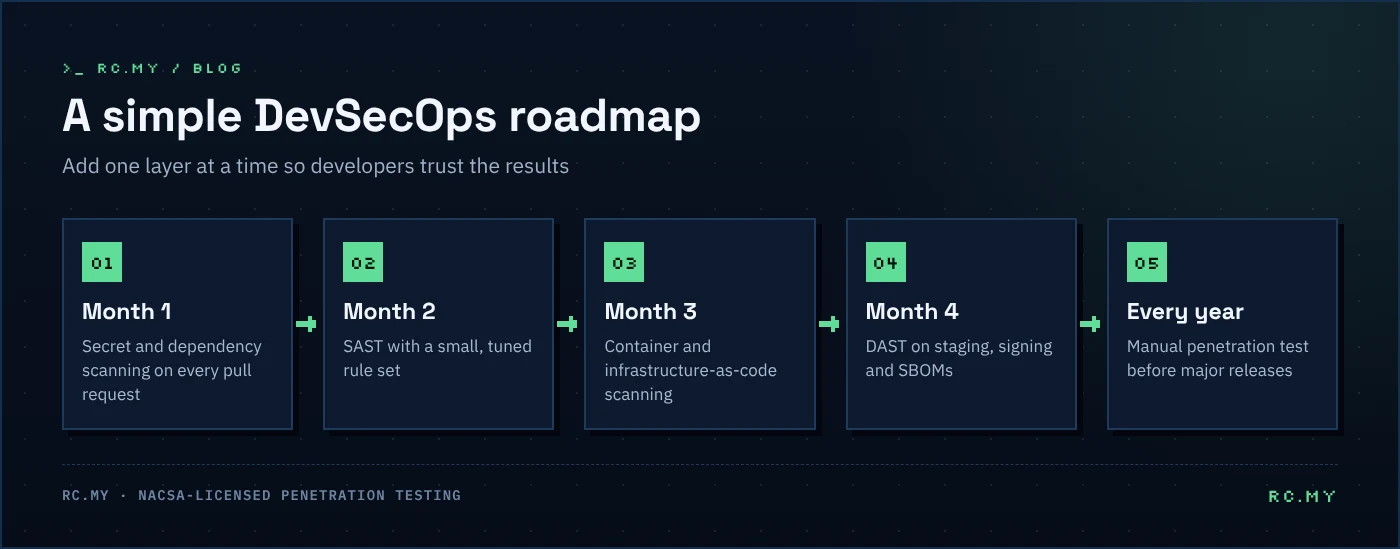
- Month 1: secret scanning and dependency scanning on every pull request.
- Month 2: SAST with a small, tuned rule set, so developers trust the results.
- Month 3: container and infrastructure-as-code scanning.
- Month 4: DAST on staging, plus signing and SBOMs for releases.
- Every year and before major releases: a manual penetration test to find the logic flaws that tools miss.
Common mistakes to avoid
- Turning on every rule and flooding developers with false positives.
- Failing builds on low-severity findings from day one.
- Treating tools as a replacement for skilled reviewers and testers.
- Forgetting to fix the findings, not just collect them.
Frequently asked questions
Is DevSecOps a tool or a culture?
Both. Tools automate the checks, but DevSecOps only works when developers, operations and security share responsibility for the outcome.
Does DevSecOps replace penetration testing?
No. Automated checks find many common issues early, while penetration testing finds complex, chained and business logic vulnerabilities.
Which CI/CD platforms support DevSecOps?
All major platforms, including GitLab CI, GitHub Actions and Jenkins, can run the tools mentioned in this guide.
Build a secure pipeline with RC.MY
RC.MY helps teams design DevOps and infrastructure solutions with security built in, from containerisation and cloud automation to penetration testing. Explore our services, learn hands-on skills through PARC Academy, or contact us.